
News
News
FTFL - Everything Quantum All at Once
This article appeared in our October 2026 issue of From the Front Lines, Bowen’s roundup of news and trends that educate, inspire and entertain us. Click here to subscribe.
Fresh off a two-day immersion into all things Quantum Computing, we have officially caught “the Quantum bug.” We are sure many of you are still preparing for AI doomsday, and haven’t had much time to focus on Quantum. Accordingly, we thought you might appreciate an early industry primer – apologies to our readers that are already well-versed in Quantum, as this month’s newsletter may seem rudimentary.
What is Quantum Computing? It’s not simply a faster computer. It fundamentally rethinks the entire concept of computing. Let’s break it down and compare it to classical computing.
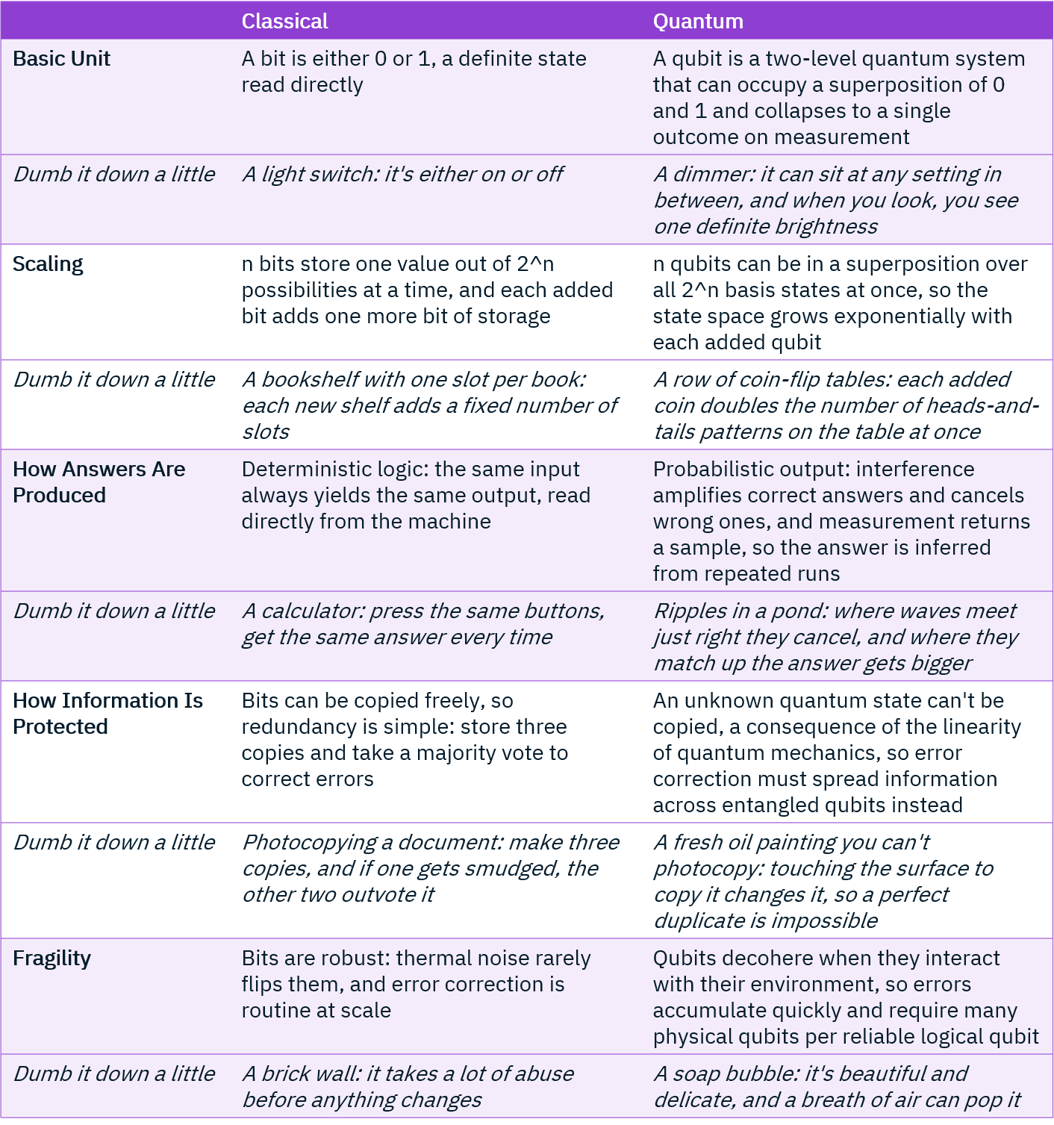
The purpose of QC is to solve enormously difficult problems that arise from optimization: finding the best answer among an almost unimaginable number of possibilities. What might that mean in the real world? Here are just a few examples of how Quantum Computing can transform industries:
- Drug discovery – accurate simulations of molecular interactions could enable pharmaceutical companies to more quickly identify promising new drugs
- Battery materials – using simulation of materials at the atomic level, EV battery makers could develop a battery that charges faster, lasts longer or costs less
- Cryptography – a hacker with a sufficiently powerful quantum computer could break RSA encryption
The possibilities are powerful, but also scary. The threat of QC cracking today’s supposedly uncrackable encryption could upend hundreds of billions of dollars’ worth of global digital infrastructure. The cybersecurity industry will need to catch up, and fast.
Switching gears to the capital markets side, we took a look at VC investing in Quantum Computing. As expected, QC is still a small fraction of total VC funding, but it’s growing fast. We compared it to the early years of AI funding and found something interesting – AI and QC track pretty closely from the point where each first eclipsed $1B in annual VC funding. See how AI 2007-2013 stacks up against QC 2021-2026.
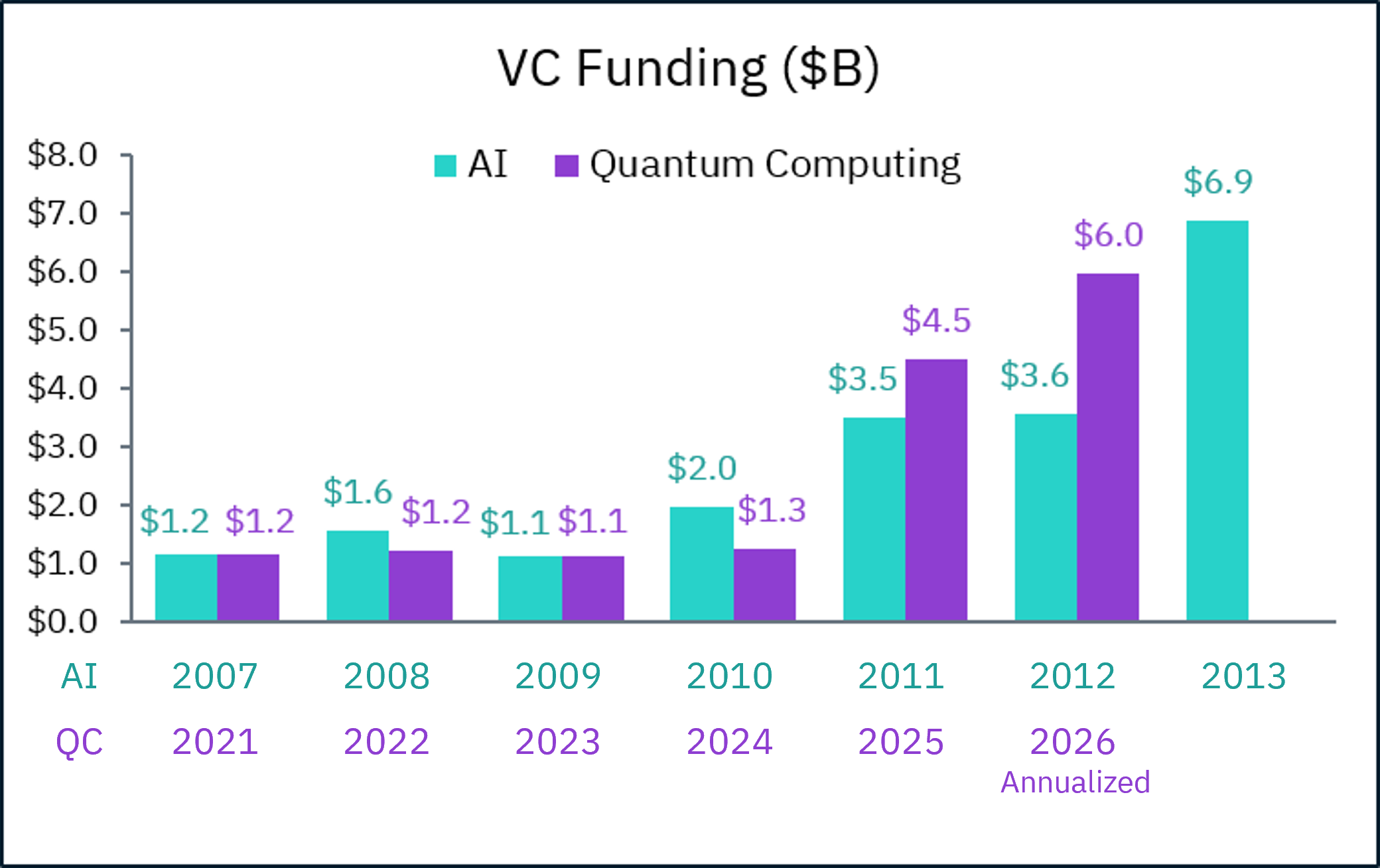
Both fluctuated around $1B-$2B for 4 years, then surpassed $3B in year 5. But now QC appears to be on a faster growth pace, currently at an annualized rate of $6B this year.
Quantum growing faster than AI? The future looks bright for Quantum entrepreneurs.
Sure that early AI comparison is cute, but we live in the world today. All VC money is going into AI – over $500B YTD in 2026 – no one wants to hear about Quantum.
Perhaps, but $217B of that >$500B this year, and over $300B overall, has gone into just two companies – OpenAI and Anthropic. And as we’ve noted before, that $300B (and then some) is going to be returned and reinvested in the private markets once lockups expire on the Big Two’s IPOs. So we’re talking about a massive amount of upcoming VC liquidity looking for a home, a windfall only 12 to 18 months away.
For those trying to time the market, the chart above offers another insight. Note that it took 15 years from AI crossing $1B in VC funding in 2007 to its big reveal to the masses – the 2022 public launch of ChatGPT. That would imply ~2036 for Quantum’s coming-out party.
Still a decade away? Perhaps that time is needed for the industry to settle on a dominant architecture – Superconducting, Trapped Ion, Neutral Atom, Photonic, Topological, something else. But after talking with several folks in the industry and listening to experts, we’re not convinced a single winner is necessary. Different quantum modalities can coexist (just like PCs and Macs, or Nvidia GPUs and Google TPUs do today), while the broader technology stack continues to mature. The industry doesn’t need to pick a winner before it can take off.
And commercialization is already underway. Did you know you could buy a Quantum Sensor for $3,600 today?
Progress is accelerating. We don’t think Quantum needs another decade to capture the world’s attention.
Our bet: the Quantum Leap happens by 2030.
