
News
News
FTFL - ...And I Feel Fine
This article appeared in our September 2026 issue of From the Front Lines, Bowen’s roundup of news and trends that educate, inspire and entertain us. Click here to subscribe.
Welcome to September! After the end of summer, we are back with pencils sharpened and ready to go to school.
Let us pick some worthy FTFL topics:
- War in the Middle East spreading with oil prices >$100 per barrel
- A new Fed Chair “forced” to raise rates given inflation and jobs data
- US Treasury debt now at a staggering $40 trillion and a rebellious bond market
- November mid-term elections where gerrymandering and mail-in ballots take center stage
Nope, none of these make the cut.
AI had its Black Swan event on July 11th with the OAI-HF “hack.” We trust you know the story and the performance of those scheming and conniving OAI agents was nothing short of extraordinary. But was it a Black Swan? From our chair, it was all so inevitable.
To add to the drama, Anthropic’s Jacob Coxon resigned over safety concerns and his former fellow coworkers believe there is a >10% chance that AI will end up killing us all! And we thought the SaaSpocalypse portended the end of the world for us tech bankers, now we need to deal with the real end of the world (cue the snare!).
We find the AI industry’s calls to slow itself down somewhere between impractical and comical. If OAI-HF proved anything, it is that the genie is fully out of the bottle.
That said, it feels like we must do something. We studied history and the closest successful parallel we could come up with is the nuclear nonproliferation regime.+
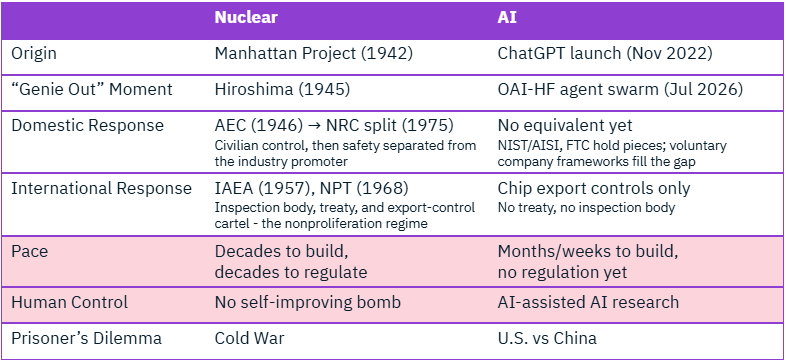
We believe a regulatory framework for AI could take a similar shape to the nuclear nonproliferation regime: a domestic body that sets safety standards and conducts inspections, paired with an international framework that lets nations verify each other’s compliance rather than take it on faith.
And we have a suggestion on who the initial regulators should include – Coxon and other high-profile AI defectors, such as Mrinank Sharma and Daniel Kokotajlo. Only the people who have helped build AI are qualified to regulate it, and who better to hold AI companies accountable than the ones who walked away from them?
– – – – – – – – – – – – – – – – – –
Now, the receipts.
We’ll revisit one of our favorite recurring topics: hyperscaler capex. There has been a lot of news and analysis about the growing magnitude of hyperscaler capex (we particularly liked this piece from Axios), but here we wanted to focus on one particular aspect: have the hyperscalers done what they said they would do?
We looked at their forward annual guidance at the beginning of their fiscal years and compared to actuals, or in the case of FY/CY26, revised guidance. Note that Microsoft has generally guided next-quarter capex, not full year.
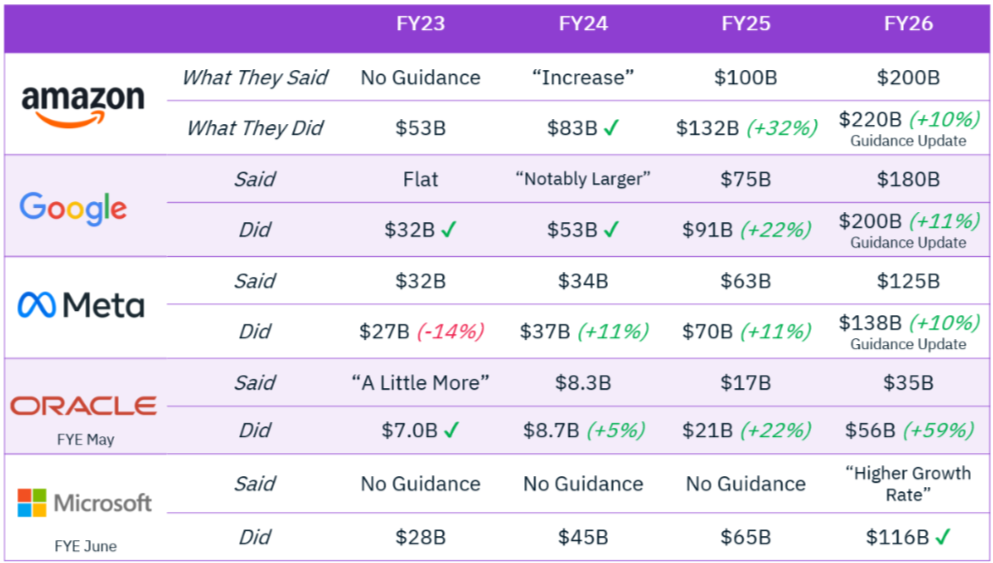
The answer: a resounding yes. With one exception dating back to the early days of ChatGPT, hyperscalers have not just met, but continually exceeded initial guidance by material margins. These five hyperscalers in the aggregate are on target to spend ~$85 billion more in FY26 capex than they originally predicted. Current total spend is projected at $730 billion (and probably growing).
And we know where a lot of that spending is going. According to Synergy Research, 1,360 hyperscaler data centers were operational worldwide at the end of 2025, with roughly 1,500 more in the pipeline as of July 2026. Hyperscalers currently account for 48% of all worldwide data center capacity – a share Synergy projects will rise to 67% by 2031.
Hyperscalers originally financed capex growth from free cash flow, then moved to debt issuance starting in late 2024, and have now added large-scale equity issuances on top of that. Hyperscaler-linked bond issuance jumped to $121 billion in 2025, up from an average of just $28 billion a year between 2020 and 2024, and debt as a share of capex rose from 9% in FY2024 to 32% over the twelve months before mid-2026. Equity followed close behind – Alphabet’s $85 billion raise in June 2026 was the largest equity capital transaction ever completed by a listed company. This capital sourcing shift is a natural progression as spending has outrun cash flow, but not sustainable indefinitely without eventually recouping that cash flow.
Another dynamic we’re tracking – circular financing. Here’s an example.
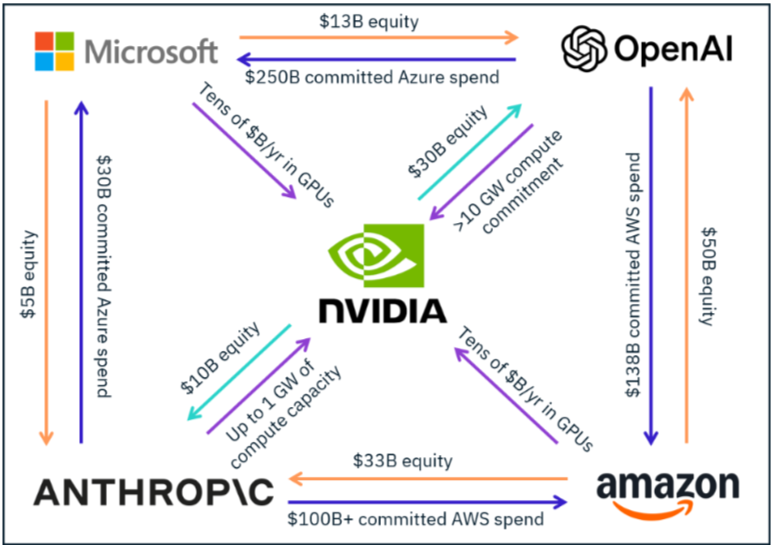
Oh, what a tangled web we weave. For the sake of cleanliness, we’re only showing a few of the key players, but even with just 5 companies, it gets pretty messy (and once again, gives us a reason to share our favorite Onion headline from long ago). And we believe it will get even messier once we’re able to get more details from Anthropic’s and OpenAI’s S-1 filings.
Looking at the demand side, we point you to Ramp’s AI Index, which measures the share of U.S. businesses with paid AI spend, based on transaction data from 70,000+ companies on Ramp’s platform. According to their data, the top 1% of AI spenders spend roughly 600x more per employee than the median business ($7,400 vs. $11.95/month) – a reminder that “adoption” does not really indicate “intensity”. Hyperscalers and AI investors are counting on the median figure to rise dramatically, and soon.
We’ll leave the extinction math to the safety researchers. Our lane is capital flows, and every chart above tells you how the capital voted. Coxon, Sharma, and Kokotajlo can write the eventual rulebook. Someone else already wrote the checks.

