
News
News
FTFL - Software Engineers, Where Will They Go?
This article appeared in our February 2026 issue of From the Front Lines, Bowen’s roundup of news and trends that educate, inspire and entertain us. Click here to subscribe.
Claude Code is having its viral moment. If it seems like everyone is talking about it, it’s because they are. The examples are stunning – coding projects that used to take a person weeks are now being completed by AI in hours.
This month we take our growth tech magnifying glass to what we believe will be the major theme for 2026 – AGI and its impact on software engineers. If you look and listen very closely, headlined by Anthropic CEO Dario Amodei, we are somewhere between 6 to 12 months away from AGI writing 100% of all software coding.
Let us state that again, in 2026, software engineers will no longer need to write code.
For the tech industry this is tectonic – like San Andreas Fault tectonic.
Let’s get into it. We’ll start with the software job landscape. Software engineering has been a high-growth job market for over 20 years, until very recently…
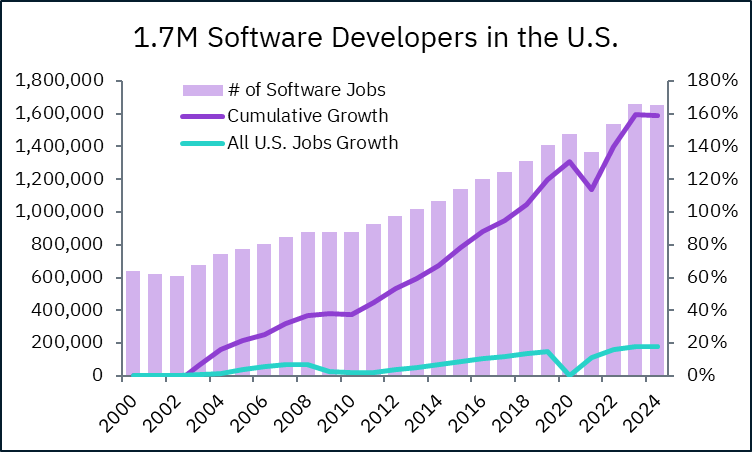
Per the Bureau of Labor Statistics, the number of software developer employees in the US has grown 159% since 2000, compared to the total US job market, which has grown 18% over that same period. Note the ever-so-slight decrease at the upper right of the purple bars. After years of sustained growth (that was interrupted only by a global pandemic), 2024 saw software jobs drop for the first time in 25 years without any associated broader economic downturn.
You may have heard about last year’s Stanford study that shows that since the launch of ChatGPT in late 2022, employment by early-career young people in AI-exposed fields including software engineering and customer service is down 16%. It appears that the software hiring reduction has been happening before Claude Code even existed.
We call this the Great Software Engineer Migration, and it has already had a major effect on the stock market – the “SaaSpocalypse.” SaaS stocks have seen a correction, driven by the rapid improvement, popularity and implications of Claude Code.
Digging into some of the bigger SaaS names, we see that the price declines were not driven by any poor financial performance.
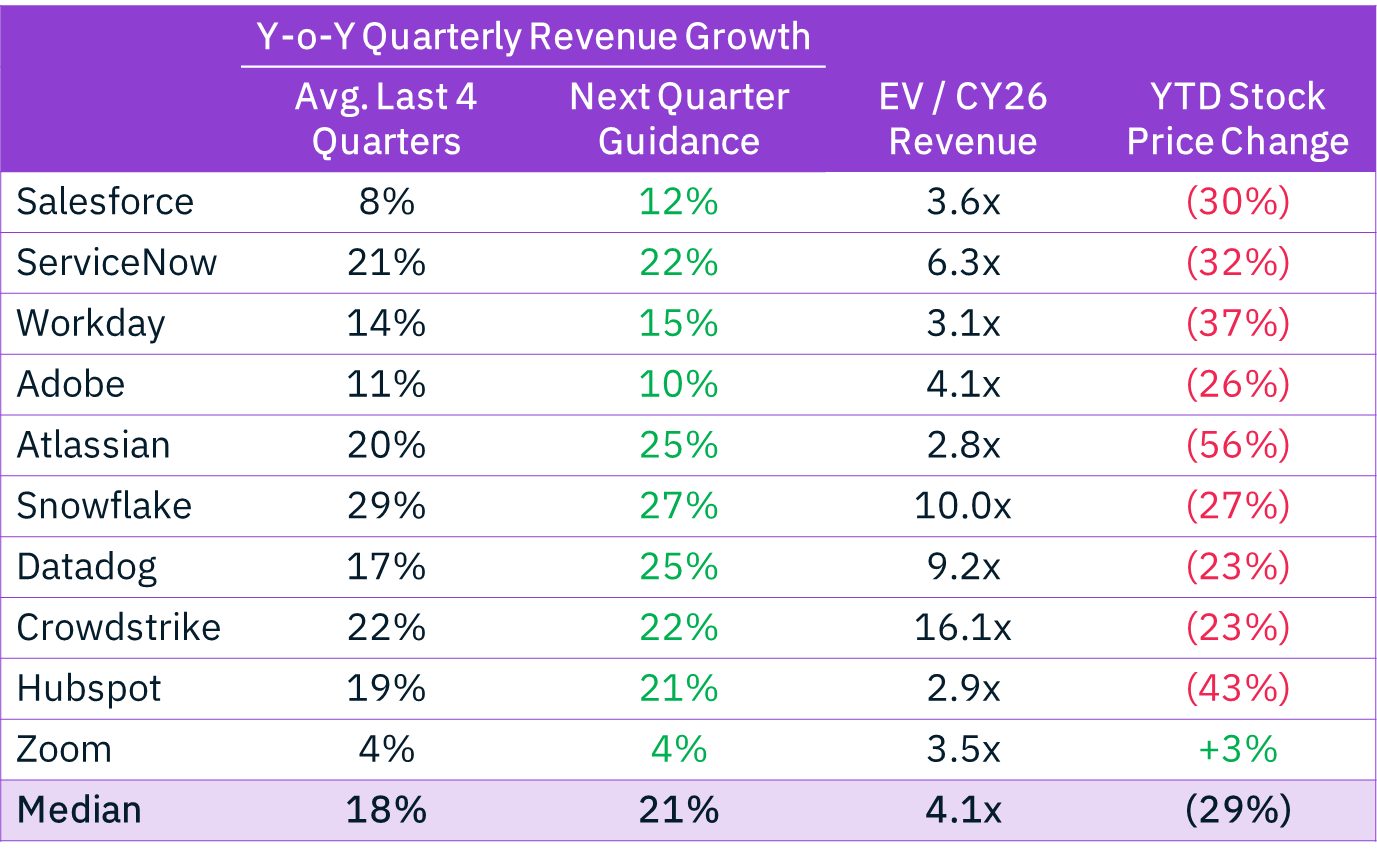
Despite healthy growth and guidance, SaaS stocks are down 29%. The issue is not this quarter’s revenue. The issue is whether AI agents collapse the traditional SaaS model altogether. If software becomes autonomous rather than assistive, the number of human “seats” paying for tools shrinks – and valuation models reset accordingly.
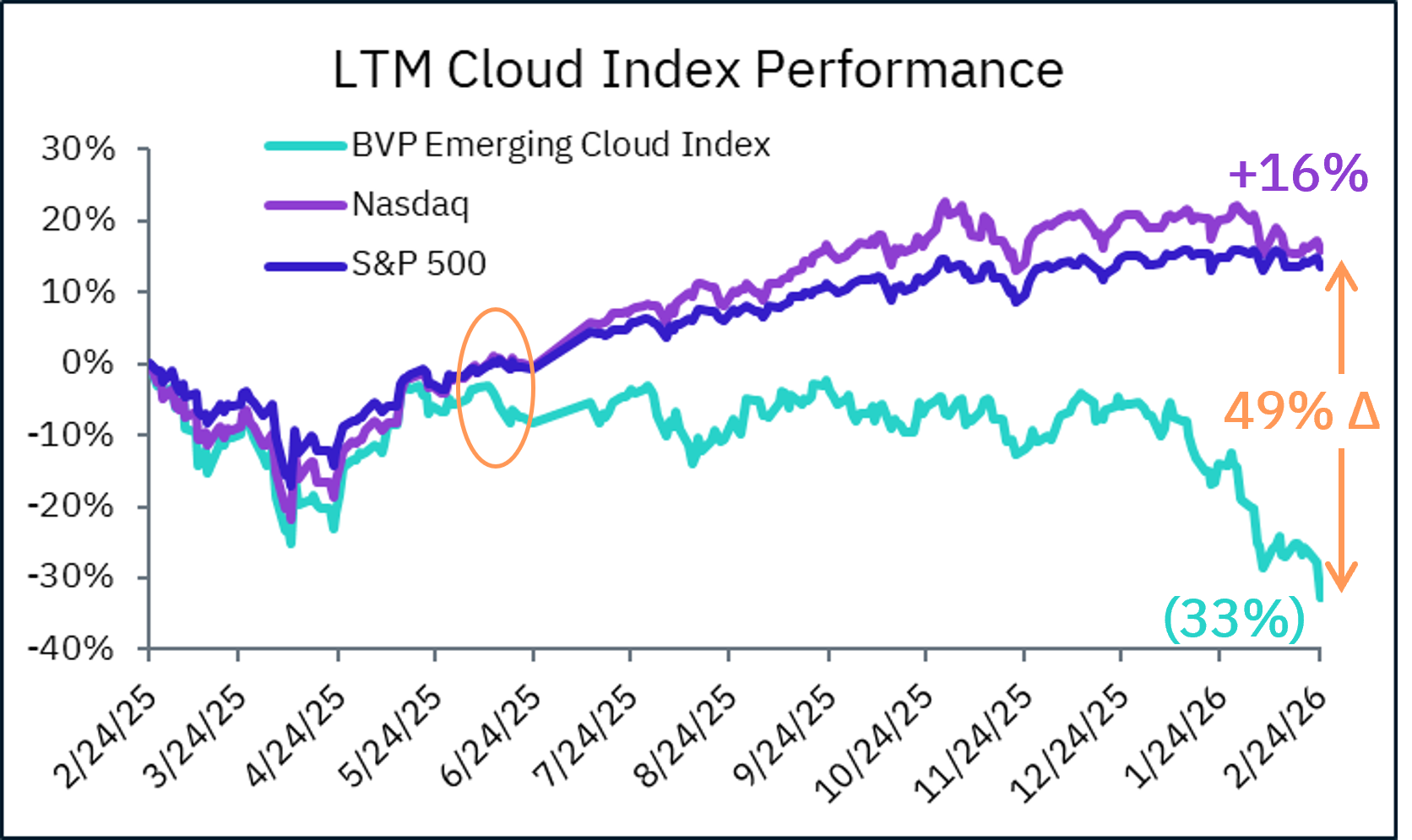
The SaaSpocalypse actually goes back further than just YTD. Looking at the past year, cloud stocks started dramatically falling behind the field about 8 months ago (orange oval below), and there is now a 49% delta between the Nasdaq and cloud stocks. It appears that this recent movement was just everyone else catching up with what many investors were already seeing.
So where does this leave software engineers when AI can already write code better than humans?
It is clear from our opening chart that the 1.7 million software engineering jobs – after 25 years of near unabated growth – are in for a dramatic decline. We believe that the number of US software engineers will decline by at least 50% by 2030.
But the crux of our FTFL is where will they go?
To answer this question, we talked to several thought leaders in our network. As is the case during most periods of massive transition, we found passionate responses on both sides of the debate.
First we have to recognize what is happening with software as a product category, and we are already seeing a fundamental change in business models. SaaS is getting flipped around to Service as Software, where AI agents performing tasks for customers will replace platforms that enable customers to complete said tasks.
This means the role of a software engineer will have to change. For a glimpse of how that might look, take a peek at Palantir, an early pioneer of the Service-as-Software model. A decade ago, Palantir coined the term Forward Deployed Engineer, a person who sits at the customer site and designs to the customer’s specifications in real time. That is the future of today’s software engineer – a customer specialist that manages AI agents to solve customers’ problems. You might think, “wait, isn’t that just a consulting model?” Well, how many consulting shops do you know that trade at 40x forward revenue?
Is computer science a dead career path, a dead field of study? We think not. While writing software might be dead, understanding software remains a critical function. Software engineers created AI, they are the closest humans to knowing how AI machines function. Business models are ever-changing, and writing code may go away, but critical thinking never dies.

