
News

News
FTFL - Talking Tariffs from Big Tech to Growth Tech
This article appeared in our June 2025 issue of From the Front Lines, Bowen’s roundup of news and trends that educate, inspire and entertain us. Click here to subscribe.
As we make our rounds and try to assess the impact of tariffs upon the growth tech industry, a common refrain we hear is: “it is really hard to put tariffs on software.” If we take a wider view, is the tech industry generally immune from the Great Tariff War?
And has the G7, headlined by the European Union, not de facto been engaged in significant protectionist policies against the US tech industry now for nearly a decade? The Digital Markets Act and the Digital Services Act coupled with the preceding General Data Protection Regulation (GDPR), have resulted in significant fines imposed upon Big Tech.
Is there really a difference between unilateral tariffs and unilateral fines? Tuh-MAY-toe, tuh-MAH-toe, anyone?
For our June FTFL, we set out to tackle these little talked about, non-hardware or products or goods related tariff issues.
We started at the top of the food chain – how have regulators around the world fined Big Tech recently? Thanks to some data tracking by Proton and CMS, we can see that Europe has led the way.
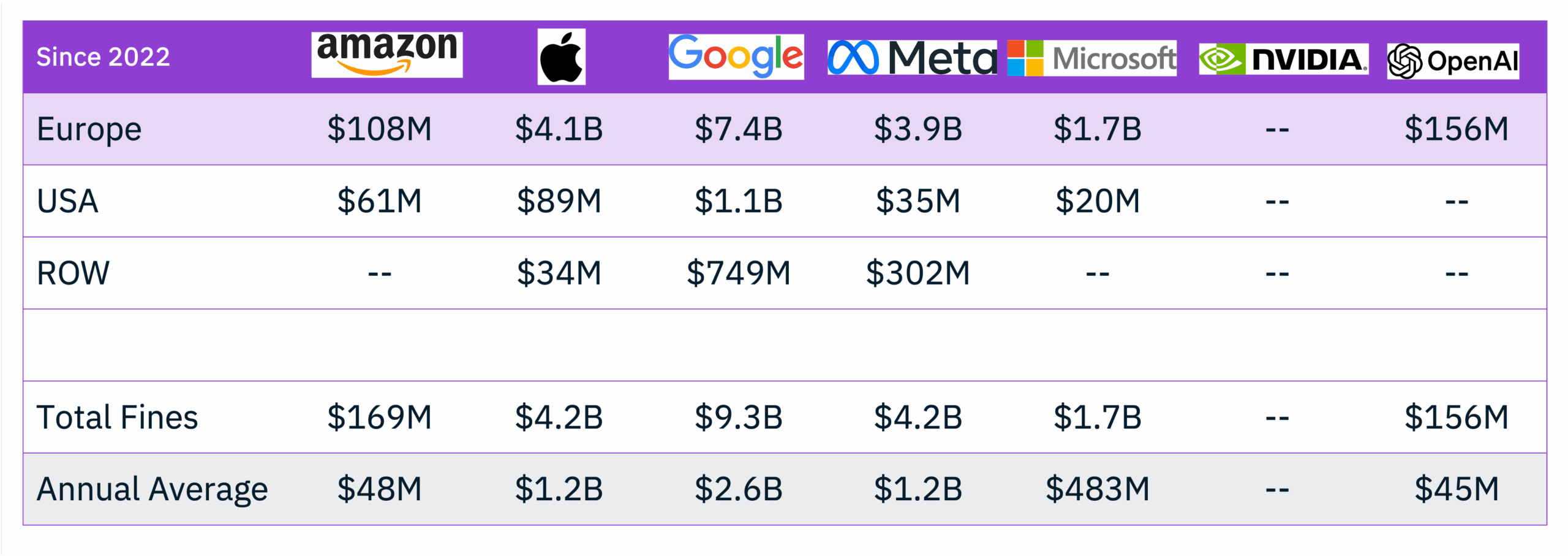
Europe has fined Big Tech $17.4 billion over the last 3.5 years – more than 7x the rest of the world combined.
Let’s compare this to two data points from recent earnings calls. Apple said that tariffs would add $900M in costs to Q2, and implied that future quarters would be higher – call it ~$5 billion in annual costs. Meta said that its annual capex forecast would increase by $8 billion due to tariffs. So immediately for these two companies, tariffs will have a significantly greater cost impact than the $1.2 billion they each pay in annual regulatory fines. We expect Amazon, Google and Microsoft, each with massive cloud businesses dependent on imported data center infrastructure, as well as NVIDIA and OpenAI with enormous AI infrastructure, to all similarly experience tariff costs that outweigh fines.
Note that $5 billion and $8 billion for Apple and Meta represent only 2-6% growth in their total spend (COGS + opex + capex). A seemingly large dollar figure that is actually relatively small. Let’s bring this analysis closer to home. How might tariffs affect companies much further downstream, in the land of software growth tech?
To try to figure this out, we analyzed the cost structures of 10 of our recent software clients. One thing became quickly clear – with no manufacturing, none of the companies are directly affected by any tariffs. However, a few spending categories are indirectly affected – primarily capex (e.g. laptops) and cloud hosting (e.g. AWS). We group these as technology expenditures. These vendors source much of their products and infrastructure overseas, and there is an industry-wide expectation of higher prices due to tariffs.
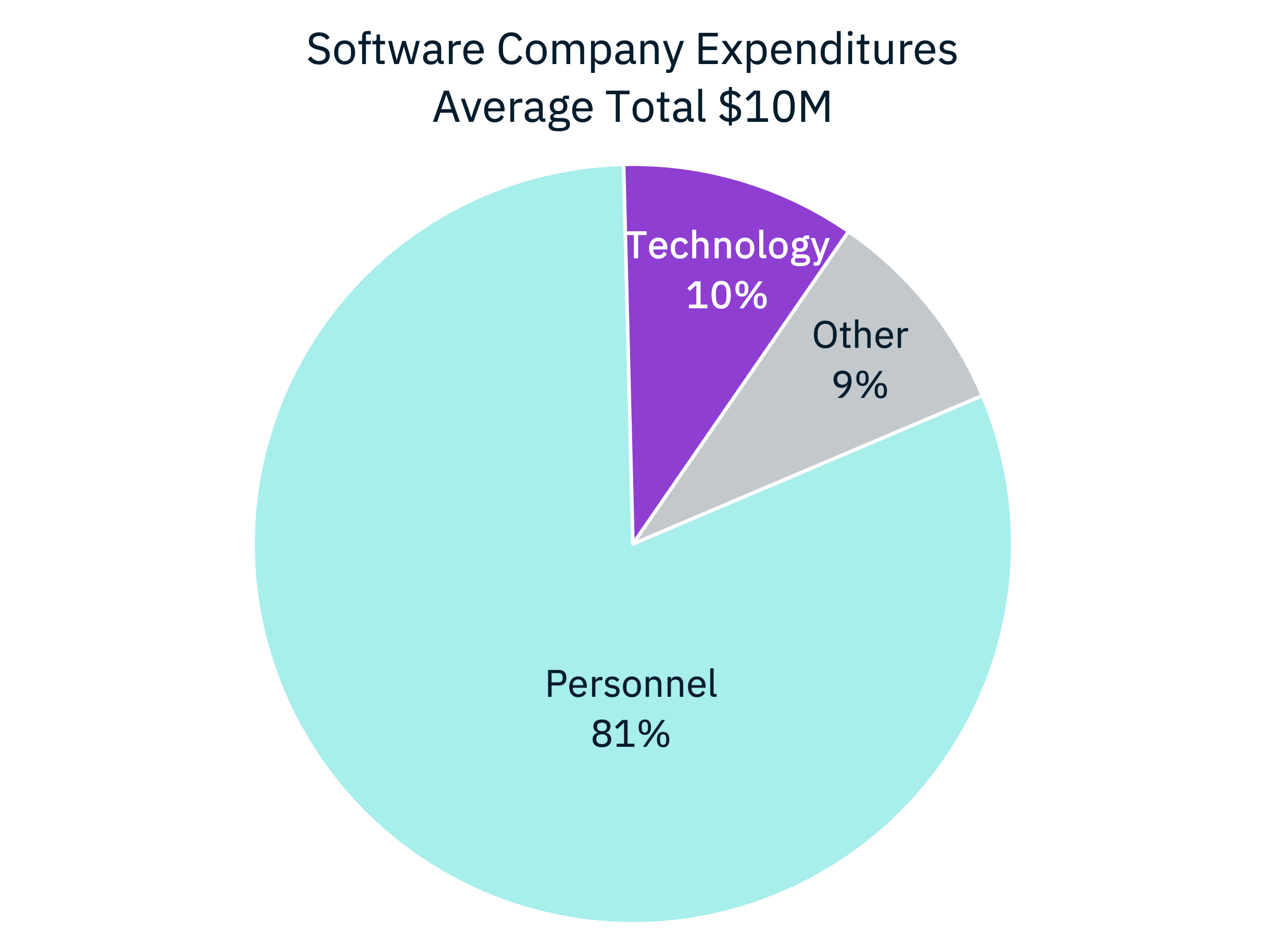
These 10 software companies, with an average total annual spend of $10 million, spend 10% of that total on “tariff-adjacent” items – i.e. technology. With Microsoft recently announcing a 20% price increase on several consumer products due to tariffs, we now have a proxy for what laptop vendors and cloud service providers might do. We believe growth tech software companies will see increased costs on par with Apple, or 10% x 20% = 2% of total spend. Not immune, but not a huge deal.
But what about that giant pie piece in the chart above? People are the overwhelming majority of software companies’ costs. Companies vary in their overseas headcount strategy, and have always been subject to in-country taxation and transfer pricing. But what if the White House decides they want to reshore coding? Currently there are no taxes or tariffs on digital transfers, and no significant taxes on maintaining foreign cost centers. And as we’ve seen over the first 4+ months of this administration, policies can change quickly. But as we’ve also seen over the past 30 years, no industry is better than tech at adapting to (and more often driving) monumental change.

